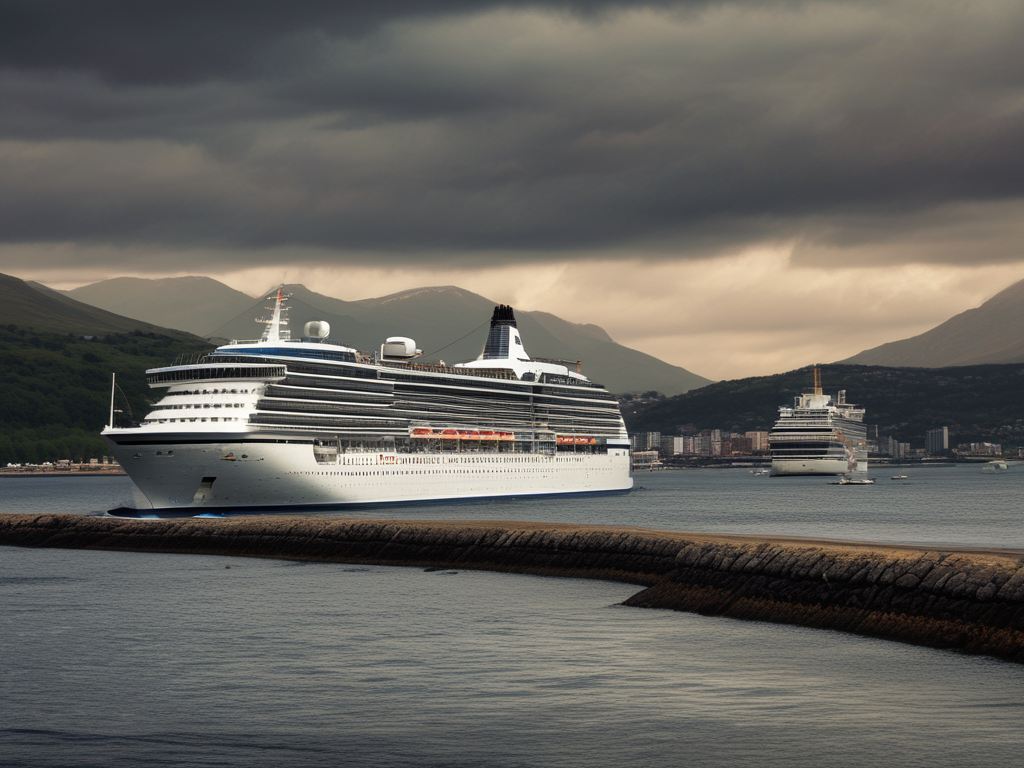
A last-minute surprise extraordinary cruise on NCL Jewel that was too cheap to pass up became my next cruise costing me only $323 USD ($823 less $500 in Cruise Next Coupons) for 14 days! It was cheaper to cruise than to stay home I told myself. Then there is always the airfare to get there that can make a “deal” not such a deal. But with some leftover Iberia Airlines credit from a cancelation earlier this year, got me from Mexico City to Madrid. Then I added Puerto Vallarta to Mexico City with miles from Aeromexico and I had to purchase 2 tickets (Lufthansa & Icelandic Air); from Madrid to Tromso, Norway, and Reykjavik, Iceland back to Madrid for about $800 USD, making the whole trip worthwhile. However, not easy! It would take 5 different flights with layovers along the way; from Puerto Vallarta to Mexico City to Dallas to Madrid to Zurich (8-hour layover) to Tromso. And then coming back from Reykjavik to Amsterdam to Madrid to Mexico City to Puerto Vallarta.
However, the itinerary was a great unique one going from Tromso, Norway; to Harstad, Norway; to Alesund, Norway; to Bergen, Norway; to Lerwick, Shetland Islands; to South Queensferry/Edinburgh, Scotland; to Kirkwall, Great Britain; to Torshavn, Faroe Islands; then finally to 5 ports in Iceland; Djupivogur, Seydisfjordur, Akureyri, Isafjordur, Grundarfjordur; ending in Reykjavik. This was 13 ports in 14 days, so a very active ports cruise. We did have to lose 2 ports in Iceland and add two more sea days because of the inability to tender due to high waves and winds. This time of year the weather can be and is a bit risky, but we had mostly 50s in most ports with some being sunny and beautiful and others cold and windy.
My starting day in Tromso, after 5 flight segments to get there, was a bit stressful because my luggage went missing by Iberia Airlines from Dallas to Madrid and I had no idea if it would make the ship or if it would be sent further along in the trip. So as soon as I land in Tromso, I am off to the stores and mall to buy clothes, medicines, and shoes for the next few days or even 14 days! A few hours later, I was ready to board and since the check-in was being done on board, it was a smooth fast process, especially when I had no luggage to worry about. Doing some research, I was told to file a missing luggage report with Guest Services and they would do the follow-up calling and tracking necessary. To my surprise a day later Iberia “found” my luggage in Madrid and it could be retrieved there……NOT! I told them what my next few days’ itinerary would be and I expected them to send it to the port agent to an upcoming port, which they did, and it ended up being back to me in Bergen, Norway; 4 days later. YAHOO!

We are off that late evening around 8pm from Tromso, Norway to our first port of call Harstad, Norway just down the coast. You have to realize that Tromso is about 217 miles NORTH of the Arctic Circle and is considered the most populated city in the Arctic Circle with about 75,000 inhabitants. It is the place to see the northern lights in the winter months and features old wooden houses and the famous Arctic Cathedral. Unfortunately, we did not see the northern lights as it was overcast during most of the cruise.
We arrived in Harstad, Norway still north of the Arctic Circle, where I had arranged an NCL tour; Panoramic Harstad & Countryside. This tour took us around the 3rd most populated city in Norway located in central Hålogaland. Noted for its Viking history, it is a largely farming area located on many islands with the capital city being Harstad. The center of the oil industry for northern Norway is located here and it is important to note that when oil was discovered in the North Sea, Norway made sure that the money first came back to the people of Norway before corporate profits. These funds are now being used to provide a secure long-term retirement fund for its retirees. A detour drive takes us to the miniature village in the village of Kasjford which was created by the artist Norwegian Kathrine Witzøe.


After a day at sea, we find ourselves in the next port of Alesund, Norway. Alesund is also located on several islands (7) and is considered the shipping hub and main fishing city for the area. The town was completely destroyed in 1904 due to a fire that raced through the town of mostly wooden structures. Rebuilt shortly after with the help of many Norwegian architects and now constructed of stones and mortar with an Art Nouveau style, making it unique. From the top of Aksla viewpoint, you can see most of the city and the islands where several are connected by tunnels and bridges. We get to spend a few hours in the Atlanterhavsparken Aquarium where the live feeding of penguins and seals is fun to watch!


The next port of call is the last in Norway to the city of Bergen. Bergen is a UNESCO World Heritage site because of its rich history as a fishing city with a wharf dating back to the 10th century. Also ravaged by fire in 1955, the city was rebuilt with only 62 structures remaining from that period. The main street along the wharf is currently undergoing a renovation and restructuring project because those buildings are sinking into the water underneath. Our tour started with a Fløibanen funicular to the top of Mount Fløyen to see the city from above. Then we went down to the wharf area including a stop at the fish market.


We leave Norway and start our stops at some unique islands, the first of which is the city of Lerwick on the Shetland Islands. I was looking forward to this stop because I have had several Shetland Sheep Dogs and wanted to see them in their natural habitat. While we did see Shetland Ponies, Shetland Sheep, and Shetland Bees; I was disappointed to not see any dogs! Lerwick is the main town and port for the Shetland Islands which are located about 125 miles north of Scotland. It became a strategic point for the defense of Great Britain during WWII and has a rich history in regard to those days. Nowadays it is a fishing and ferry port and one should note that the entire island is treeless. This is due to the constant gale force winds over the islands which prevent their growth. Our tour of Shetland Ponies & Scalloway Castle takes us to the far other side of the Shetland Islands to Scalloway where a museum was built to honor those war efforts.


We are off to the next day to Edinburgh, Scotland via the port of South Queensferry a short 20-minute drive from Edinburgh. This is a tender port and I have booked the NCL tour; Leisurely Edinburgh. We are met at the pier by the bus, but I depart a little earlier to see what is going on nearby and I happen into a fish & chips place called Da Harbour Chippy made with fresh halibut, excellent!


South Queensferry is famous in its own right because it has the Forth Railroad Bridge and the Forth Road Bridge connecting this area to the north across the Firth of Forth. It is designated as a UNESCO World Heritage site because of its design as the longest cantilever bridge in the world in 1890.


Our subsequent drive through Edinburgh was shortened due to time constraints and it was mainly a driving tour around the city with no stops.


The next port of call leads us to another set of unique islands, the Orkney Isles to the city of Kirkwall which are still considered a part of Scotland. Here I had signed up for the NCL tour; South Island Panoramic. This was quite an interesting tour as it crossed miles of farmlands with lots of sheep and cows, across various man-made causeways, and ended up first at the Italian Church. Built by Italian POWs in WWII using Nissen huts and any materials they could find in the area. With a final stop in the village of St. Margarets Hope, we had seen various shipwrecks in the area from storms over the years.


Our final set of islands is the Faroe Islands with our stop at the capital city of Torshavn. I have booked another NCL tour; Easy Faroe which was a bus tour as far as the remote village of Skykkio with its grass-roof houses. The Faroe Islands are a territory of Denmark, however, have their government and parliament covering 18 islands in total. The roads are very good and include many tunnels to get around and through the mountains with lots of Faroe Sheep to be aware of as you are driving around. The views along the drive are spectacular and you can see the uniqueness of these islands. Just like the Shetland Islands, it is treeless for the same reasons.


As we leave the islands and head to the big island of Iceland with 6 ports of call scheduled, I look forward to seeing more of Iceland than I did back in the 2 ports of call Akureyri and Reykjavik on my 2019 cruise. While Iceland is unique in its own way, once you have seen the major sites of the waterfalls, geysers, and volcanic activities, the various ports around the island seem to be very similar. We ended up visiting only 4 of them because of sea conditions; Seydisfjordur, Akureyri, Isafjordur, and finishing in Reykjavik.


In summary, it was a great interesting cruise with lots of new ports for me to see and add to my list of new countries and new cities. It was interesting to note that over 400 Australians were on this cruise, so my journey to Tromso, Norway did not seem that far! I also met some very interesting people like Barbara Jean who I hope we see again on a future cruise. She was great fun and reminded me of my dear friend Jane Peabody!

Leave a Reply