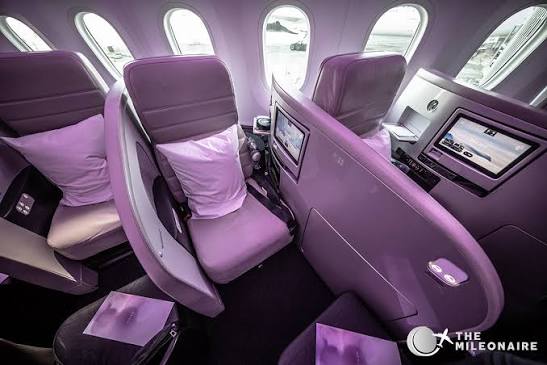
A lie-flat seat can turn a 12-hour flight from Mexico City into a manageable overnight, but only if you choose the right one. Business class seat selection is not about chasing the lowest seat number or copying a seat-map legend blindly. The difference between a quiet window suite and a seat beside the galley can determine whether you arrive in Paris, Tokyo, or Buenos Aires ready to explore or needing a recovery day.
After flying long-haul business class on a wide range of airlines, I have learned that the cabin name matters less than the exact seat. Even within the same aircraft, some seats are noticeably better for sleeping, working, eating, or simply being left alone. The good news for solo travelers is that many of the best seats are easy to identify once you know what to look for.
Start With the Aircraft, Not the Airline
An airline can offer an excellent business-class experience on one route and an older, less private cabin on another. Before selecting anything, confirm the aircraft scheduled for your flight and then look at the cabin layout for that specific version. This is especially relevant from Mexico City, where a carrier may use a flagship aircraft on one European departure and a different configuration on another.
A 1-2-1 layout is usually the safest starting point for solo travelers because every passenger has direct aisle access. You will not need to step over a stranger when you wake up, and nobody needs to climb over you. That may sound minor while booking, but it matters at 3 a.m. when the cabin is dark and everyone is trying to sleep. I have found that the Boeing 787 aircraft provides the best comfort with the 1-2-1 layout. The Airbus A380 also provides the same layout, but the specifics of comfort relies back on the the actual airline.
Older 2-2-2 or 2-3-2 business-class cabins can still be comfortable, particularly on daytime flights or when the fare is substantially lower. But they involve compromises. A window passenger may be trapped by their neighbor, center seats can feel exposed, and storage is often limited. I would not automatically reject one of these cabins, but I would be realistic about what I am buying: a flat bed and better service, not necessarily the privacy of a modern suite. Recently, I was on that 2-4-2 configuration on a Boeing 777-300 with British Airways and it was the smallest most claustrophobic seat I had every experienced! Luckily my aisle neighbor was kind enough to switch with me.
Know the difference between staggered and reverse-herringbone seats
Many newer business-class cabins use either staggered seats or reverse-herringbone seats. Reverse-herringbone seats angle toward the windows and usually offer consistent privacy and good personal space. They are a dependable choice for solo flyers.
Staggered layouts can be excellent, though the experience varies seat by seat. Some window seats sit close to the window with a large console separating you from the aisle. Others are closer to the aisle and feel more exposed. On a staggered map, do not assume every window seat is equal. Look for the seats described as “true window” positions, often alternating by row. The most bizarre has to be New Zealand Business Class where everyone has their feet towards the aisle with no usual footwell under the seat in front of you.
Business Class Seat Selection for Sleep
For an overnight flight, sleep is my priority. I would rather be farther from the door and get six uninterrupted hours than be first off the plane after sleeping badly.
The quietest seats are generally away from the galley, lavatories, and bassinets. Galleys bring light, clattering dishes, crew conversations, and the occasional stretch of turbulence-related activity. Lavatories create footsteps, flushing, and passengers waiting nearby. Bassinet positions are not always a problem, but if sleep is the purpose of the flight, I do not deliberately choose one.
I also avoid the last row of business class unless the seat map makes it clear there is a solid divider behind it. On some aircraft, that row is close to premium economy or the main cabin, where foot traffic and noise can continue after business class has settled down.
A window seat usually wins for sleep because there is less passing traffic and one side of the seat feels naturally sheltered. On an aircraft with individual suites and closing doors, the advantage is smaller, but I still prefer the window for an overnight. It gives me a better sense of having my own small space. I then tend to try to be in the middle of the cabin so rows 4-5 are my favorite.
There is one exception: if I have a tight connection after landing, I may choose a seat closer to the front, provided it is not right beside the galley. A 10-minute head start through immigration can be useful at a large airport, especially when a Mexico City connection has already left little margin. Still, the gains are often overstated. On many international arrivals, immigration and baggage claim erase most of that advantage.
Choose Privacy According to How You Travel
For a solo traveler, a window seat with direct aisle access is almost always the best answer. I like being able to settle in, organize my things, and disappear into a movie or sleep without feeling part of the aisle traffic.
Couples face a different decision. Center pairs may be ideal if you want to talk, dine together, and share the flight experience. Yet some center configurations place passengers surprisingly far apart, with fixed consoles between them. In those cabins, two window seats across the aisle may actually be more comfortable, especially on a red-eye where both people plan to sleep. Many times my partner and I like the window seats, so we sit behind each other in the 1-2-1 configuration.
Privacy also means considering sightlines. A seat can have a high shell yet still face directly into another passenger’s space when the cabin lights are on. If you are sensitive to that, select a seat with the console on the aisle side or one positioned farther from the walkway. These details are more valuable than a marketing photo of a perfectly empty cabin. One of my favorite things to do is find that airlines specific business class review on YouTube. From there I really get a feeling of the seat details, locations, and configurations of the aircraft.
Do Not Ignore Storage and Footwell Size
The headline features of business class are easy to compare: lie-flat bed, door, direct aisle access. The practical details can matter more over a long flight.
I pay attention to where I will keep a water bottle, headphones, phone, passport, reading glasses, and charging cable. Some seats have a deep side compartment and a useful counter. Others provide almost nowhere to put small items once the bed is made. If you travel with camera gear, medication, or the usual collection of cables needed on a long trip, accessible storage is not a luxury.
Footwell size deserves equal attention. In staggered cabins, certain seats taper sharply at the feet. A narrow footwell may be perfectly acceptable for a daytime flight, but tall travelers or side sleepers can find it frustrating overnight. This is where an honest seat-specific review is more useful than broad statements that a cabin is “fully flat.” Flat is not the same as spacious.
Bulkhead seats sometimes offer a wider footwell or extra room, but they may also be near bassinets, galleys, or lavatories. They are worth considering if legroom is your main concern, not because bulkhead automatically means best.
When a Less Popular Seat Is the Better Choice
Not every trip calls for the same ideal seat. On a daytime transatlantic flight, I may take an aisle-adjacent seat if it makes getting up to work, stretch, and photograph the wing easier. On a short business-class segment within the Americas, I care more about easy access and an earlier meal than a perfect sleeping position.
If I am traveling alone and the flight is nearly full, I also prefer a good seat in a quieter rear mini-cabin over a mediocre seat near the front of a larger cabin. Smaller cabins can feel calmer, and the service may be more attentive simply because there are fewer passengers. The trade-off is that meal choices sometimes run out sooner in a rear cabin, depending on how the airline loads and serves the flight.
Seat maps also change. Aircraft substitutions happen, particularly around weather, maintenance, and seasonal scheduling. Choose the best available seat, then check your reservation again a few days before departure and once more at online check-in. If the aircraft changes, your carefully selected 3A may become a completely different product.
A Simple Way to Make the Final Choice
When I am deciding between several open seats, I ask four questions: Can I sleep without aisle interruptions? Can I access my belongings easily? Is the seat away from obvious noise? Does it suit this particular flight rather than some imaginary perfect flight?
That final question keeps business class seat selection practical. A window suite is wonderful on an overnight from Mexico City to Europe. An aisle seat near the front can make more sense before a short connection or on a daytime route when I expect to be awake. There is no universal best seat, only the one that gives you the best chance of arriving ready for the trip you actually planned.
The most satisfying business-class flight is rarely the one with the flashiest suite. It is the one where you sleep when you need to sleep, have your essentials within reach, and step off the aircraft with enough energy to start enjoying the destination.
Enjoyed my latest blog, then click here for much more!
Leave a Reply